
Introduction to Car Design: Where to Start and What You Need to Know
Hello everyone!
Today, I want to start the first part of our new series called "Car Design Series" introducing the world of car design. I’ll talk about what the field of automotive design actually involves, where you can start, what you need to know from the beginning, and how you can approach this field as a future car designer.
What Does a Car Designer Actually Do?
The first thing you need to understand about automotive design is that it has many different sub fields and the people working in these areas can all be considered as car designers. So the name "car designer" is one, but related to many positions in this field.
For example, someone who creates a sketch by hand on paper is a car designer. This could be a simple two dimensional drawing made with a pencil or pen.
Then there is the person who takes that sketch and adds colors and visual informations to it. In automotive design, we often refer to this process as rendering. The designer uses colors, reflections, highlights, and other visual techniques to communicate the material and surface of the vehicle. For example, they can show whether a surface is made of steel, plastic, glass or another material. They can also communicate whether the surface is glossy, matte, textured, metallic and so on. This can all be done traditionally on paper. Btw this is a little old way and the newer one is called digital design.
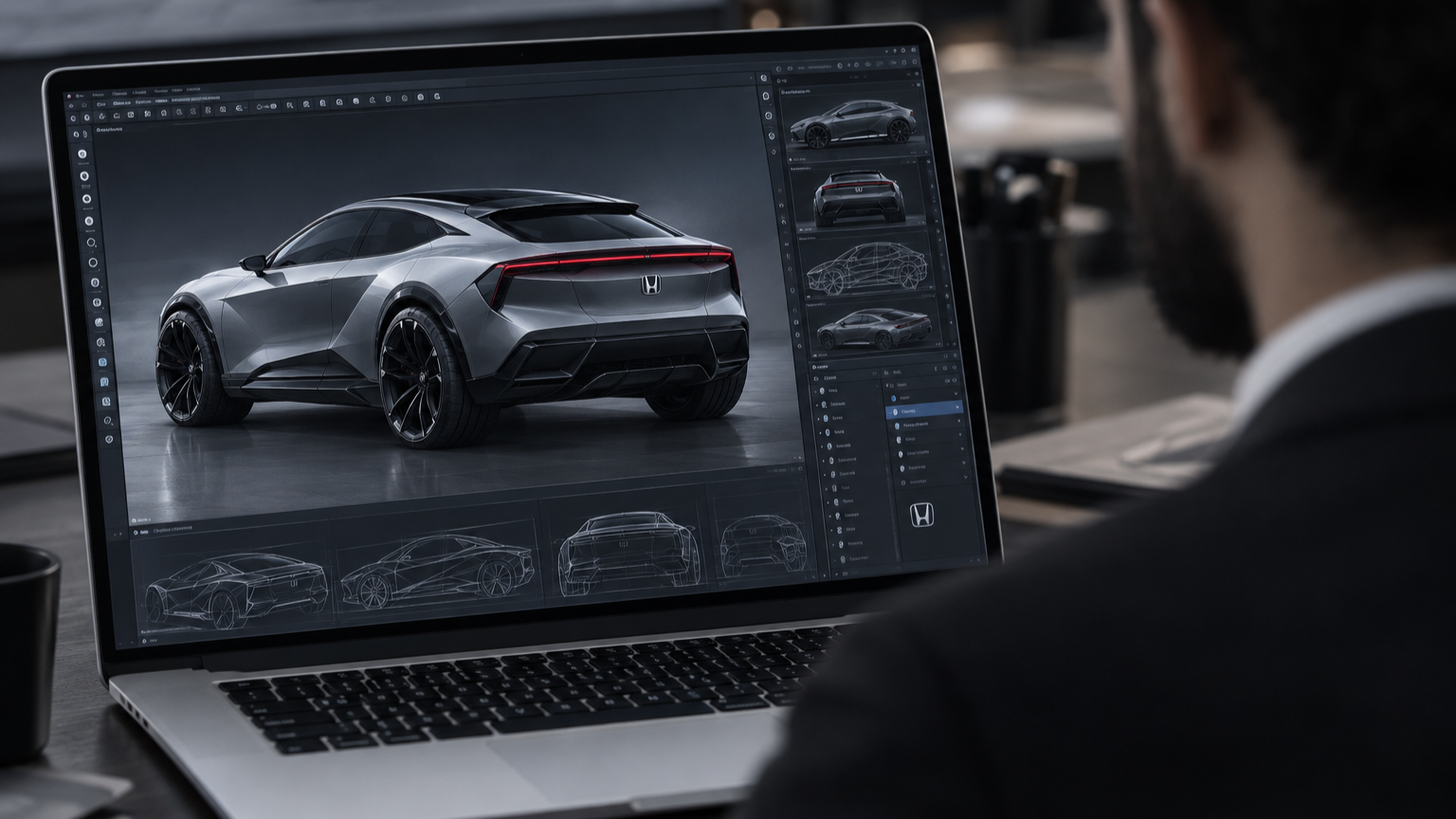
The same process can also be done digitally. A designer may use Photoshop, Sketchbook, Illustrator or other digital software to create sketches, develop two dimensional designs, add materials and produce what we generally call a 2D rendering. That person is also a car designer.
And then there is 3D designer. Someone who develops ideas in 3D and designs a car using computer aided design (CAD) software is also a car designer.
There are also specialists who create physical models. This can be similar to sculpture but for automotive design only, often using industrial clay. Others may create physical models using 3D printing, cardboard, foam, wood or almost any other material.
There are also people who work on technical analyses related to automotive design such as aerodynamic analysis, manufacturing feasibility, and engineering related studies connected to car design process and development. All of these people are working within the broader field of automotive design, and many more that I can not mention them all.
What Does a Pro Car Designer Need to Know?
Now comes the important question:What does a professional, successful, high level car designer need to know and what path should they follow?
One of the best ways to understand this is to look at people who are currently working as automotive designers in major companies. What skills do they have? What skills did they need when they were hired? What does a company actually look for when hiring a designer?
The first thing you should understand is that every one of these areas is a world of its own, almost an ocean of knowledge. You can specialize in one of them, or you can work across several areas. And these are not the only fields that exist. New specialties can have different roles over time, and some areas can also develop through a combination of different topics.
Some areas such as sketching, have existed for a very long time. Others, such as physical model making, have been part of automotive design almost since the beginning of the automotive industry itself. Physical model making is still an important part of car design today. A model can be built at a small scale, such as 1:18, meaning eighteen times smaller than the full size real car, or it can be built at 1:1 scale, meaning exactly real size. The people who create these models are commonly called clay modelers when they work with automotive clay. You may also hear the term model maker, particularly when referring more broadly to people who build physical car models. In other words, these are specialists who create physical representations of a car before the final production version is built.
Specialize in One Area But Understand The Full Process
All of these people eventually specialize and focus on a particular area. So, you should eventually choose an area to focus on. However, you should also study and understand the entire car design process.
But why? Let me give you an example from cooking!
A chef is focused on cooking food. They are not necessarily a specialist in cookware, but they still need to understand which type of pot or pan is appropriate for a particular dish, what kind of material the cookware should have, and which tools are suitable for different cooking processes.
For example, there are wooden spoons, metal spoons, and many different cooking utensils. A chef needs to know when and how to use them.
A chef also knows about individual ingredients. They know what turmeric, cinnamon, pepper, saffron and other spices do to the food taste.
Does that make the chef a specialist in spices? Not exactly. They simply have enough knowledge about spices to use them effectively in their own work.
There are also things that matter after the cooking process. A chef needs to understand how a dish is traditionally served, what foods complement each other, and how different ingredients are normally combined. The chef may not be a nutritionist, but being a successful chef requires having a broader understanding of the subject.
Automotive design is the same!
You may be designing the vehicle itself, but you still need to understand the things surrounding that vehicle. First, you need to understand the customer and the market. How should the customer feel when they see or use this vehicle? What is the vehicle going to be used for? What features and options does it have? What are the different engine or powertrain characteristics? How do those features affect the vehicle and the way people perceive it?
You may not be the person who develops the engine or creates the vehicle's technical systems and you may not be a manufacturing specialist. You are a car designer but you still need to understand these areas.
Understanding Where Ideas Come From
You also need to understand where a design idea comes from. You should be able to recognize people's tastes and preferences. You should understand automotive history. For example, how did we go from very early forms of personal transportation such as bicycles and horse drawn carriages to the cars we have today? Why did certain design directions become popular while others disappeared?
These are not necessarily subjects in which you need to become a specialist. But you do need to study them. A car designer should understand what happens before the design process, during the design process and after it. Before design, there are ideas, inspiration, research and design theory.
After design, there is engineering, manufacturing, production, delivery to the customer and eventually the customer's experience with the car. You need to have enough knowledge of all these stages to understand where your design fits into the larger process.
The Psychology Behind Car Design
There are also very specific principles in design that may seem simple at first, but can have a significant effect on how people perceive a vehicle. One exercise in industrial design (which automotive design is a part of) is to give a student a square and a single dot, then ask them to communicate the concepts of lightness and heaviness using only that dot.
How can you do it?
Placing the dot toward the upper part of the square can create a visual impression of lightness, while placing it toward the lower part can create a feeling of heaviness. This kind of visual language has been used in car design for many years.
For example, on some generations of the Mercedes Benz C Class, the position of the rear brake light elements could be interpreted as contributing to a feeling of stability, weight, and stopping.
Think about body language. When we want to communicate calmness, we may move our hand slowly downward, toward the ground. When we want someone to stand up or raise something, we naturally move our hand upward.
These gestures communicate meaning without using words. Automotive design works with many of these same principles. You may not consciously recognize them when you first look at a car, but they can strongly affect your perception. The visual language of a vehicle is one of the things that separates something like an older Ford from a Lamborghini or a Bugatti.
A trained designer understands these principles. They understand visual language, proportions, surfaces, forms, graphics, and the psychological associations created by different design decisions. They also study why people's tastes change over time and how cultural and technological changes influence what people consider attractive or desirable. This knowledge can help a designer develop a car as a product that communicates a specific idea or emotional character.
What Is a "Concept" in Car Design?
Most people do not consciously analyze these design principles. But they still feel their effects. For example, you might look at a Lamborghini and immediately think: "Wow! What a fast and powerful car!"
But you haven't even opened the hood. You don't know what engine is inside. I mean itcould have the engine of an old Ford or even worse than that!
You reacted to the design. You are receiving a feeling from the shape, proportions, surfaces, stance, details and overall appearance of the car. That feeling and overall idea are closely related to what designers call a concept.
When we say concept design, we are essentially talking about designing and communicating a particular idea, character or experience through the car. So when someone says that a car had a concept developed before production, it means that a design was created to explore and communicate a particular direction or feeling before the final production vehicle was developed.
Why Do Car Companies Create Concept Cars?
Automotive manufacturers regularly reveal concept cars at different points in time. You often see headlines such as: "Company X Reveals Its New 2025 Concept." The important thing to understand is that a concept car is not necessarily the final production vehicle. A concept may be shown at an auto show or through the media to explore how people respond to a particular design direction.
The company may want to know:Did people understand the intended idea? Did they respond positively to the character of the vehicle? Did the concept communicate what the designers wanted it to communicate?
If the response is useful, some of the design elements may eventually make their way into a production vehicle. Some elements may be modified before being used. And some may never be used at all. A company may ultimately decide that a particular design direction did not communicate the intended message to the market and choose to abandon it.
Not Every Design is About Beauty
There is an important fact. Automotive companies are not always trying to create something that people immediately consider beautiful. Sometimes a company is trying to introduce a completely different concept or value proposition to the public.
Tesla is an interesting example. With vehicles such as the Cybertruck, and with some of its other models, the objective was not necessarily to say: "Look how beautiful this vehicle is."
The idea could instead be understood as: Forget traditional expectations about beauty. Focus on what makes this vehicle different such as its electric powertrain, technology, functionality or efficiency.
In other words, the message can become:
"This vehicle has value because of what it is and what it can do, even if its design does not follow traditional ideas of beauty."
It is almost like saying: "Even if I sell you a simple box, if it provides the technology and functionality you want, you should still want the product." This kind of strategy can change what consumers expect from a car. And this is another reason why understanding automotive design is much deeper than simply knowing how to draw a beautiful car.
A car designer is not only drawing shapes. They are communicating ideas and emotion and function, identity, technology, culture and a vision of what a vehicle is supposed to be. That is why learning automotive design requires much more than learning how to design something beautiful. It requires understanding the whole world around the automobile.
We will publish the next episode at ms3d.net/blog soon! Thanks for reading... :)