
Please read the subject again. The question is not why not Solidwork or another software then why Alias instead. It is why not solid modeling and why surface modeling?
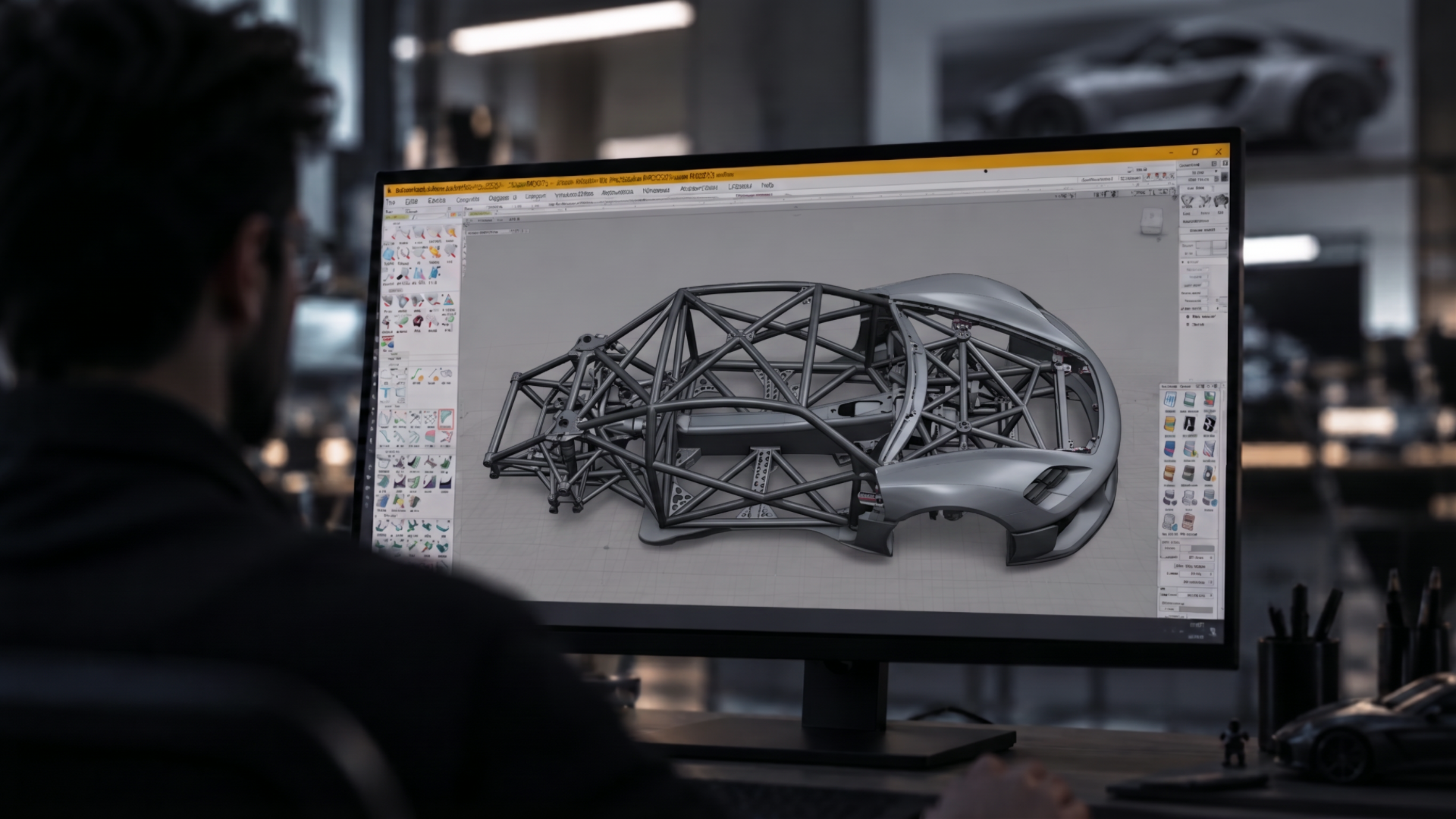
The question is fundamentally about why MS3D Academy teaches chassis engineering through surface modeling rather than conventional solid modeling through our new course named Chassis Engineering Surfacing. This is actually an important distinction and our answer should explain the purpose of the workflow, not comparing two or more software.
The reason is simple: We are teaching automotive surfacing, not conventional mechanical component design.
Solid modeling is excellent when your primary objective is to design individual mechanical components with defined volumes, dimensions, wall thicknesses and manufacturing features. However, automotive chassis development, especially in the context of automotive design, requires a different way of thinking. We often need to work with complex spatial relationships, master surfaces, structural envelopes, packaging volumes, clearances, transitions and design intent.
Solid Modeling is excellent for designing and engineering individual mechanical components, but automotive chassis development also requires a deep understanding of geometry, spatial relationships, packaging, clearances and surface continuity. Surface Modeling gives us the flexibility to develop, manipulate, analyze and control these geometries without immediately committing to a closed solid. It allows designers and surface modelers to understand the shape and spatial organization of engineering elements before they become finalized mechanical components.
This doesn't mean solid modeling is wrong or unnecessary. In fact, both approaches are important in automotive development. But our objective at MS3D Academy is to teach automotive designers and Alias surface modelers how to understand and develop engineering related parts using the tools and workflows of professional automotive surfacing. This is very good for designer who want to work on producable projects and products.
We are not teaching you how to manufacture a chassis component (with solid modeling). We introduce different chassis types and might go deep in some engineering topics to explain the solution for challenges between designers, modelers and engineers later. Then you will know how to understand, develop and control product geometry through surface modeling. That's the difference.
The technical reasoning behind
There are several strong arguments, I explain some of them here:
1. Geometric flexibility: Surface modeling allows complex shapes to be developed and modified without requiring a closed solid at every stage.
2. Design intent: Automotive surfacing emphasizes curvature, continuity, transitions and control over complex geometry.
3. Packaging and spatial understanding: Engineering surfacing can represent chassis envelopes, structural boundaries, component clearances and spatial relationships.
4. Early stage development: Surface models can be useful when engineering geometry is still evolving and dimensions or component configurations have not been finalized.
5. Automotive industry workflow: Surface modeling and solid modeling serve different purposes and frequently coexist in automotive development.
One sentence I would use to position the course is: "Solid modeling defines the volume of a component; surface modeling gives us the freedom to understand and control its geometry." By the way there is one important clarification. Surface modeling is not inherently more accurate or more suitable for every chassis engineering task. Final structural components, manufacturing details and engineering validation often require solid models and specialized engineering tools. We don't enter that field. MS3D Academy's value is teaching the surface modeling side of that engineering workflow, not replacing the solid modeling side.
Thank you and good luck!