
Introduction to Car Design:
Where Do Car Designers Work?
In the second episode of this car design series, I want to talk about the different work environments and areas where automotive design takes place.
As I mentioned in the previous episode, one of the best ways to understand this field is to look at companies and organizations where car designers work and see what kind of people they need and what those people actually do.
This time, however, I don't want to focus on the specific roles of individuals. Instead, I want to talk about the places where car design work is carried out.
Car Design as a Professional Job
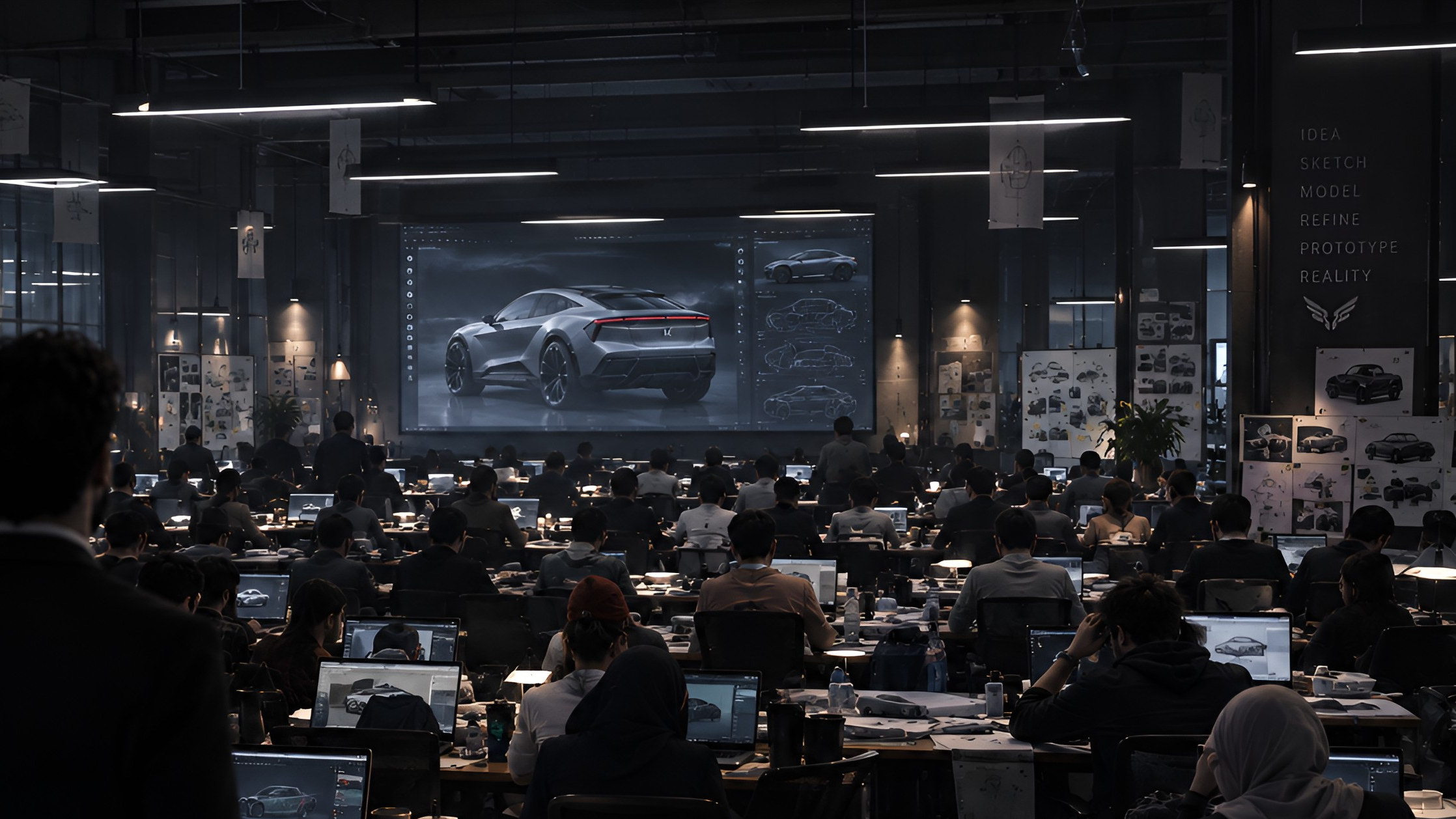
As many of you probably already know, the first important thing to understand about car design is that it is generally known as an employee work for companies. In other words, companies usually have a specific space or department for their automotive designers. We normally call this a Design Department or a Design Studio.
Inside this department, a number of people are employed directly by the company and work on automotive design projects. As we discussed in the previous part, some projects eventually reach production, while others are cancelled or abandoned. But imagine that a company is working on ten projects over a three season period. Maybe nine of those projects are eventually cancelled, burned and only one reaches production. The designers still had to work on all ten projects not only the one that will be produced.
So automotive design work is continuously happening. The fact that a concept is eventually cancelled does not mean that no work was done on it. This is why companies generally need automotive designers, even though not all of those designers necessarily work inside the main Design Department. We have more than 200 car companies around the world but only counting professional automotive designers are more than 50,000 estimately. With these numbers, even a small car company don't have only a few car designers working!
The Example of Changan
Let me explain this with an example.
Imagine a company such as Changan. At one point, I worked for them and was involved in projects C673 and C857, so I had the opportunity to see how their team operated.
Changan itself has a main design department in China, where a number of people are employed and working on different projects. But does it end there? No.
They also have a large design studio in Europe, with many people working there. You can imagine hundreds of people working in different automotive design roles. This studio is located in Turin (Italy), and is known as Changan Design Studio Europe.
The people working there are working on projects belonging to Changan. In better words, Changan may have projects that its main design department in China cannot fully handle because of limited time, human resource or any other reasons. Parts of those projects can therefore be assigned to its design studio in Italy. Because this design studio is directly connected to Changan, it becomes an extension of the company's design operation.
So, besides the main design department of an automotive company, car designers can also work in design studios that are directly connected to that company.
Multiple Design Studios Around the World
A company may have only one external design studio, or it may have two, three, or even more in different countries. The reason is to expand the team in local and global.
For example, a design studio in Italy may recruit automotive design graduates from Italian universities. It can then train and develop them through internships, education programs, scholarships and practical experience. Once these designers reach a professional level, the studio can hire them and involve them in Changan's projects.
Now imagine that a company has several studios around the world. It might have one studio in the United States, another in other countries like Brazil, Canada, Palestine or somewhere else. This kind of international design studio network is common among automotive companies.
Of course, not every manufacturer has this kind of setup. Some companies do not have separate design studios in other countries at all.
Supply Chain of Car Designers
But even those external design studios may themselves be connected to other design studios and freelance designers. These designers may work under a non disclosure agreement (NDA) and a contractual agreement, working remotely, online or in a hybrid format on specific automotive design projects.
Now it starts to look like a chain.
For example, imagine that I am a freelancer and I receive a project from a design studio based in the United States. Let's call it Lee Rosario Design Studio which is one of MS3D partners. That studio may itself be working with Ford's design studio in Italy. And that Italian studio is connected directly to Ford.
So you can see how everyone is connected like links in a chain.
Everything is connected!
What you are seeing is only one section of that chain. In the real automotive design market, there can be thousands of these chains connecting different companies, design studios, agencies, private clients and individual car designers.
A Real Example
Let me give you another example that actually happened to me.
There was a project that we worked on for a private client. That client had a design studio and we completed the work for them and received a payment. Let's say, for example, that the project was worth 10,000 Euros. Under the NDA contract, I transferred the rights to sell, distribute, publish, and own the work to that client. In return, I received agreed payment and completed the project.
Now imagine that this client themselves had a contract with another design studio. In other words, they had received the project from that studio. Let's say their project budget was 20,000 Euros. They kept half of it and gave the other half to me to complete the actual work.
Now let's go one level higher. That client had another client above them, a company that had originally allocated a 100,000 Euros budget for the project.
And then, one level above that, the company itself was connected to a manufacturing company that had ordered the project because it wanted to produce that in another country.
That higher level project may have had a much larger budget, 250,000 Euros!
The point is that each level may keep part of the budget and pass the rest down to another company, studio or a designer. This chain can therefore be created through private clients and independent studios, not necessarily through design studios that have a direct relationship with the original automotive company.
The Automotive Design Industry Is Much Bigger Than You Think
Now, think about this supply chain. You can start to understand just how large the automotive design world really is. There can be an enormous number of projects happening at the same time. And you may work on a project without even knowing that, somewhere further down the chain, it may eventually lead to a major automotive brand.
Of course, changes can happen along the way. The project may become more developed, more detailed, or completely transformed before it reaches the final client or manufacturer.
Who Gets the Credit?
There is another interesting part of this process. Usually, the final design is credited to the Chief Designer, the person responsible for the project, the Design Manager or the main designer associated with the project. But in reality, several studios and many different people may have worked on it.
Why? Because these people usually have confidentiality agreements, and they have transferred the rights to their work to the person or company that hired them. As a result, they do not have the legal right to publicly claim ownership of the final design.
At first, this might sound a little unfair! I understand your feelings... And yes, the final design may genuinely contain your artistic contribution. But you were working as part of a collaboration. You completed the work, received payment for it and gained experience from working on that project. From that perspective, the contractual ownership arrangement is part of the professional relationship.
There Are More Opportunities Than You Might Think
So now we can understand why there can be so many job and project opportunities in automotive design. A company can have multiple projects being developed at the same time. Maybe one of them will eventually reach production and maybe none of them will. Maybe a project will take several months or several years before a final decision is made. And it is completely normal for a design to be cancelled inside a design studio or an automotive company.
There can be many reasons for cancellation:
The manufacturing cost may be too high.
The design may not fit the company's technical requirements.
Customer research may show that the market is not responding as expected.
Or the project may simply no longer fit the company's goals, strategies and plans.
A Cancelled Project Does Not Mean Failure
I have personally worked on many projects that never reached the final result. Some of them were very advanced. Almost everything was ready, but the vehicle was ultimately never produced.
The important thing to understand is this:
The success of a car designer should not be measured simply by whether a project reaches production or not. What matters is how much experience you gain and what level of skill you develop while working on those projects.
Of course, having experience on production vehicles is valuable because production projects are usually much more complex and demanding. Projects that actually reach production often involve extremely challenging and time wasting... sorry time consuming work :) They require many stages, many revisions, and a great deal of coordination between designers, engineers, manufacturers, suppliers and other teams.
So, whether a project eventually becomes a real vehicle or remains a concept, the experience you gain from working on it is part of your development as a car designer. The project itself may have been a valuable part of your career.
In the automotive design industry, there are countless projects that never reach the road. But every one of them can teach you something. And that experience is one of the most important things you can carry with you into the next project.
Thank you for following MS3D on this episode.
We will publish next one at ms3d.net/blog soon... Good luck.